Knee Osteoarthritis Strength Protocol
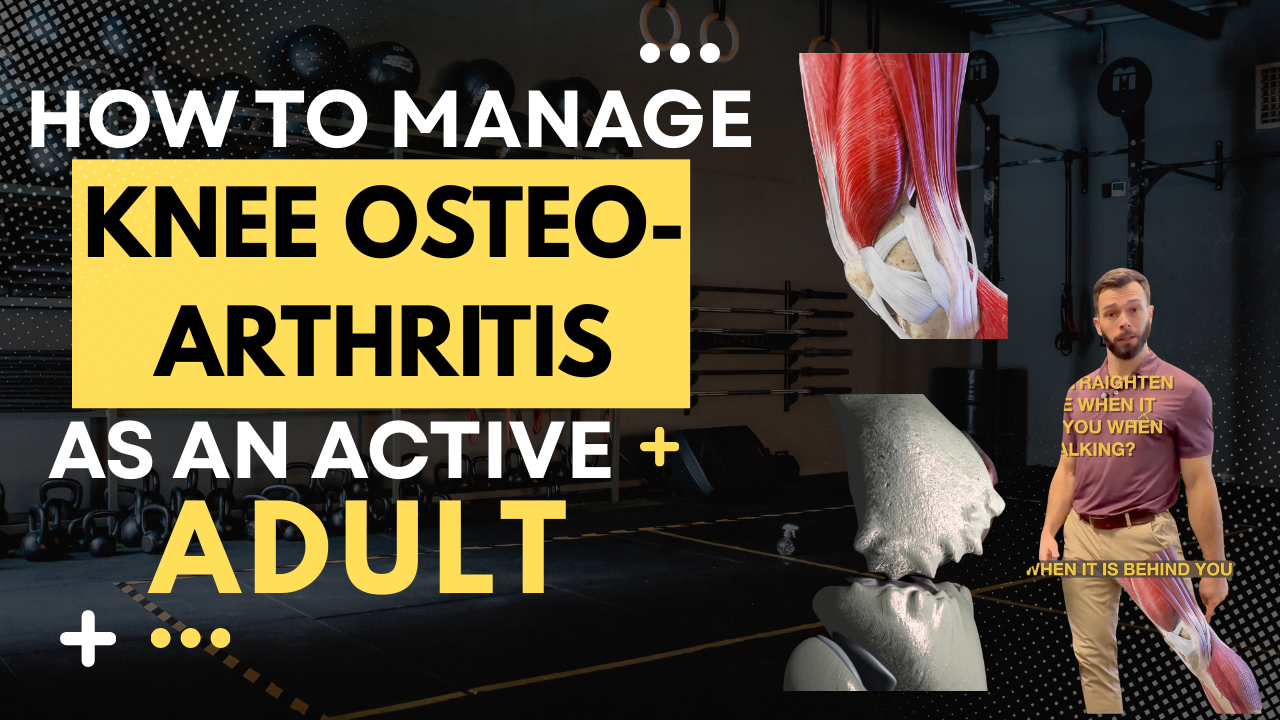
Strength Training Protocol That Keeps Active People in Their 40s, 50s & 60s Moving — Despite Knee Arthritis
By Ryan Kalkbrenner, PTP, DPT, OCS · Precision Fitness Physical Therapy
If you've been managing knee osteoarthritis, you may have already worked on mobility and reducing inflammation. But to truly slow — or even stop — the progression of your symptoms, the next step is building and progressively increasing your strength. Here's exactly how to do it safely.
Why Strength Training Is the Most Important Thing You Can Do
Research consistently shows that strength training improves function, decreases pain, and prevents further progression of knee arthritis. The key muscle to target is your quadricep — and here's why it matters so much:
Your quadricep strength is directly correlated to the load going through your knee joint. A stronger quad means load is distributed more evenly and there's typically less pain. A weaker quad means more pressure lands directly on that joint — and you feel it.
The problem most people run into is doing the same routine on repeat — wall sits, light ankle weights, bodyweight squats — without ever progressing. Your body adapts. If you don't increase the challenge, your muscles stop getting stronger, and pain can creep back in.
THE SORENESS RULE — FOLLOW THIS EVERY SESSION
Aim to stay at a 0–3 out of 10 pain level throughout your exercises. If you reach set two or three and your pain jumps from a 3 to a 5 or 6, that's too much load. You should feel muscle fatigue and mild soreness in your quads — not aching in the knee joint itself.
The 5-Exercise Protocol
For each exercise, choose a variation that is challenging but not painful. You should feel genuine muscle fatigue — leaving the session with tired legs, not a sore knee.
1. Wall Sit
Stand with feet far enough from the wall so your shins are perpendicular to the ground when you lower down. Find a depth that challenges your quads without causing knee pain — thighs parallel to the floor is the hardest variation. Do not hold onto your thighs.
Weeks 1–2: 20–30 sec holds × 4 roundsWeeks 2–4: Increase depth or add 5 sec/weekGoal: 60-second hold at parallel
2. Single-Leg Knee Extension (Machine)
Scoot all the way back on the seat so the crease of your knee aligns with the machine's pivot. If you have pain in the last 30° of extension, work only from 90° to 30°. Use a controlled 2–3 second tempo on the way up and down. If single-leg is too painful, start with both legs and progress over time.
12–15 reps × 3 sets1–2 reps left in the tank at end
3. Hamstring Curl (Machine)
Use a seated, standing, or lying hamstring curl machine — whichever is available. Focus on going through the full range of motion and feeling the contraction in the back of the leg, with no pain in the knee. Match the same rep range as knee extensions.
12–15 reps × 3 sets
4. Goblet Squat
Hold a weight in front of your chest. Keep your chest tall and use a slow 3–4 second tempo down and up. If this causes knee pain, place your heels on a 1–2 inch riser (weight plates or thick books work well) — this small adjustment often takes enough pressure off the joint while still loading the quads effectively. Go to the depth that is pain-free.
12–15 reps × 3 setsSlow tempo is key
5. Reverse Lunge
Hold onto a wall or stable surface for balance. Step one foot back and lower toward the ground, keeping 80% of your weight over the front leg. Chest stays tall with a slight forward lean. Keep your knee tracking over your second and third toe. If pain occurs, reduce the depth — even a quarter-range lunge will still strengthen your quad meaningfully.
10–12 reps each sideAdd weight as tolerated
How to Progress Over Time
Progressive overload is the principle that drives results. Here's a simple roadmap:
WEEKS 0–2
Find your range
Choose weights and depths that are pain-free. Focus on form and tolerability.
WEEKS 2–4
Expand range
Increase range of motion and/or add a few reps. Target 12–15 reps per set.
WEEKS 4–6
Add load
Begin increasing weight while dropping to 8–10 reps per set.
WEEKS 10–12+
Build strength
Target 3–4 sets of 8 reps at a weight you can barely finish with 1–2 in reserve.
Not One Size Fits All
These are general recommendations that a large portion of people with knee OA will tolerate well. However, there will always be those that this type of exercise is not enough for (or too easy) and that this is too painful or challenging. In those scenarios, more custom approaches may be needed to reduce pain and inflammation first, then progress into a strengthening routine, or start at an easier pace. Those that cannot tolerate these types of exercises also tend to do well with Blood Flow Restriction Training or BFR.
A Note on Blood Flow Restriction (BFR) Training
Can't tolerate regular loading? BFR may be the answer.
Blood flow restriction training uses a specialized cuff to partially reduce blood flow to the limb during exercise. Research shows it allows you to build strength similar to lifting heavy weights while using 50–60% less load — a significant benefit for anyone with knee arthritis who experiences pain during conventional training. BFR should be performed under professional supervision, as incorrect application carries risks. Stay tuned for our next article on BFR training and how it may help.
The Bottom Line
Managing knee arthritis is not about resting — it's about loading smartly and consistently. Progressively strengthening your quadriceps and surrounding muscles is one of the single most effective things you can do to reduce pain, protect your joint, and keep doing the activities you love for years to come.
Arthritis isn't going away, but with the right program, it doesn't have to stop you either. Learning to train through it — and manage flare-ups when they happen — is the real key to long-term success.
Ready to take the next step?
Download our free Knee Mobility eBook or apply for our Blood Flow Restriction program to find out if it's right for you.